Service
Business Management Systems
One organized system for customers, sales, staff, expenses, and reporting — instead of disconnected tools and spreadsheets.
The Problem
What This Solves
- Customer, sales, and staff information lives in separate tools
- Reporting requires manually pulling data from multiple places
- There is no clear view of what is happening across the business day to day
- Repeated manual work slows the team down
Who It's For
Built For
- Growing small and medium businesses
- Corporate service providers
- Businesses managing multiple staff, branches, or clients
- Teams still coordinating through spreadsheets and chat
What's Included
Core Features
How We Work
How We Deliver This
The same sequence on every engagement, so you always know which stage you are in and what happens next.
Map how information really moves
We trace a real job end to end — enquiry, quote, delivery, invoice — and note every point where someone re-types data that already exists. Those points become the first modules.
Start with the two modules that hurt most
Rather than a two-year platform build, we ship the pieces solving the most expensive problem first, so the system earns its keep while the rest is still being built.
Design around existing habits
Screens follow the sequence your team already works in. Adoption fails when software insists on a new order of operations for no reason your staff can see.
Permissions modelled on real responsibility
Access mirrors who is actually accountable for what, so the system enforces your structure instead of quietly working around it.
Roll out team by team
Each module goes live with the group that needs it, with training and a feedback round before the next one starts.
What You Get
What You Receive
- A modular platform covering the areas agreed in scope
- Role-based accounts reflecting your actual reporting structure
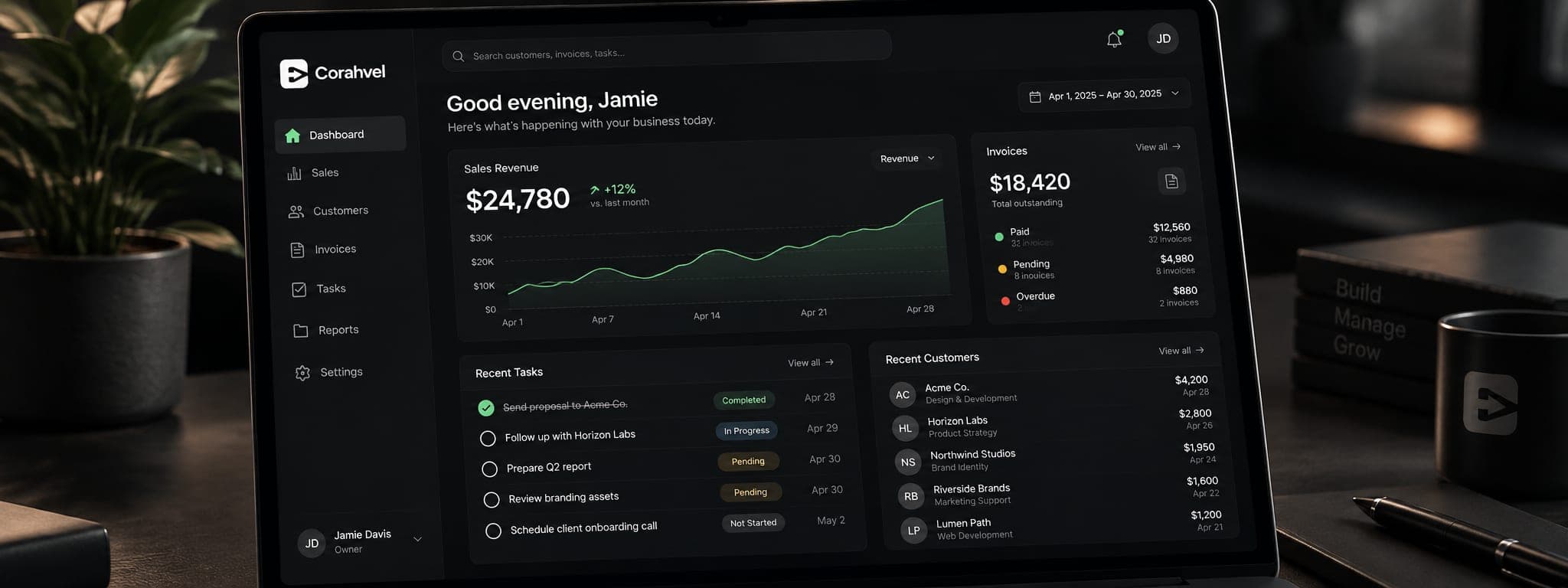
- Reporting dashboards that replace manual spreadsheet assembly
- Invoice, quotation, and document generation in your branding
- Data migrated from the tools the system replaces
- Written documentation and per-team training sessions
Typical timeline
First modules usually go live in 6–10 weeks, with further modules phased in as the system proves itself.
Every project is scoped individually. You receive a specific timeline in writing before any work begins.
The Outcome
Benefits
A single, accurate view of the business at any time
Less duplicated data entry across teams
Clearer accountability with role-based access
Reporting that takes minutes instead of hours
Working With Us
Why Clients Stay
Commitments we make on every project — the things we can be held to, rather than claims about ourselves.
Value before the full build lands
Phased delivery means you are using working software early, not waiting a year to discover whether the plan was right.
The system bends to you
When your process changes, the software changes with it. That is the entire reason to build rather than buy.
Scope is written down before we start
What is included is agreed up front. Changes are quoted openly rather than absorbed silently or invoiced as a surprise at the end.
No per-seat penalty for growing
Adding staff does not multiply a licence fee. The cost of growth stays yours to control.
We start with the operational reality — how information actually moves between teams — and design modules around that flow.
See our full processFAQ
Questions About This Service
Yes. Most clients start with the two or three modules that solve the most urgent problem, then expand the system over time.
No. The system is designed around your existing workflow, so it should feel familiar rather than technical.
Yes. Role-based access, branch management, and scalable architecture are built in from the start.
Related Services